
Olympic Games
Where can I find information about the Olympic Games?
(Years 7-10)
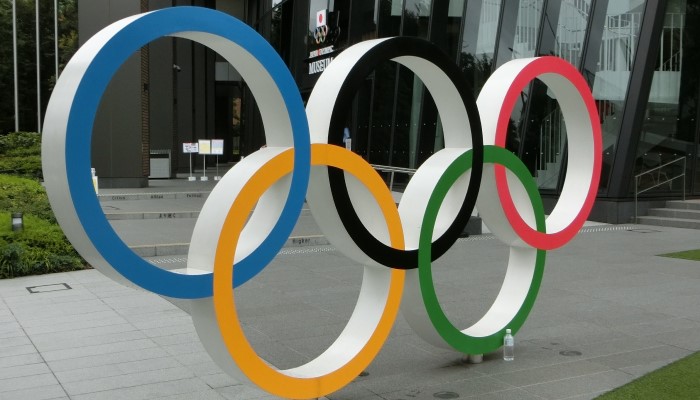
Image: The Olympic Rings in Tokyo 02 by RuinDig/Yuki Uchida on Wikimedia Commons. CC BY 4.0. Image cropped.

Entry last updated: 18/03/26
Introduction
The Olympic Games are one of the biggest sporting events in the world. Athletes from hundreds of countries meet to compete for gold, silver, and bronze medals in individual and team sports. The Olympics include the summer games, winter games, and Paralympic Games. Each type of games is held every four years, with the winter and summer games held two years apart from each other.
In this entry, we'll look at the history of the Olympic Games and the traditional symbols of the Games. We'll also look at the Winter Olympic games, Paralympic Games, and New Zealand's involvement in the Games.
Ancient Olympic Games
Sportspeople have competed in the Olympics for centuries. In this section we'll look at where, when, and why the Olympic Games started, and what the original games were like.
International Olympic Committee
This is the official website of the International Olympic Committee. They are the organisation that is responsible for organising the modern Olympic Games. It's an excellent place to find all types of information about the games including the ancient Olympics.
Select the heading IOC.
Choose IOC History.
Then go to Ancient Olympic Games.
Explore links to different articles at the bottom of the page.
Tips: We like sites that are from government or other reliable organisations, because we can trust the information. You can often tell these sites by their web address (they might have .govt or .edu in their address) but you can also look at the About Us or Contact pages.
Penn Museum - The Real Story of the Ancient Olympic Games
This site comes from the Penn Museum which is part of the University of Pennsylvania. It looks at archaeology (the study of things made by humans) and anthropology (the study of human societies).
Select the Games to find out about the games.
Choose the Women to find out about the role of women at the games.
The FAQs talks about some myths about the early games.
Tips: This website has a glossary, which is a list of the uncommon words used on the site and their meaning. If you're not sure what a word means check out the glossary. If you can't find the word listed there try using Google as a dictionary eg if you want to define the word chariot, your search would be 'define chariot '.
This site is the youth and education part of TED. It has videos about lots of different topics including the Olympics.
Search for 'Olympic Games'.
Watch the video The ancient origins of the Olympics.
If you are interested in the history of ancient cultures, have a look at the Ancient History Encyclopedia. On this website you can find timelines, articles, videos and more.
Search for 'Olympic Games'.
Read the article Ancient Olympic Games.
Or discover the article Olympia about where the games were held and the Heraia Games for women.
Modern Olympic Games
Today's Olympic Games are quite different from the ancient games. In this section, we'll look at the modern summer and winter Olympic Games.
Some modern Olympic Games:
1896 Athens : First modern Olympics held.
1916 Berlin : First games to be cancelled because of war.
1924 Chamonix : Winter Olympics introduced.
2010 Singapore : First Youth Olympic Games are held.
2014 Sochi : Most drug testing of Olympic athletes
2016 Rio : First refugee team takes part in the Olympics and Michael Phelps wins his 28th Olympic medal.
2020 Tokyo : First Olympics postponed because of a global pandemic.
This is an EPIC resource. EPIC is a collection of reliable databases covering lots of different topics, which has been put together especially for New Zealand school students. You may need a password from your school or local library to access it.
Select the Middle level.
Enter the keywords 'Olympic Games' in the search box.
Go to the article Olympic Games.
To make the information simpler or to get more information change the Reading Level at the top of the article.
Tips: To get to the EPIC resources you will need a password from your school librarian first. Or you can chat with one of our AnyQuestions librarians and they will help you online. Some EPIC databases may also be available through your public library.
Infoplease is a reference and learning site, combining the contents of an encyclopedia, a dictionary, an atlas and several almanacs loaded with statistics, facts, and historical records. There are a couple of ways to find information.
Search for 'Olympics'.
Choose Olympics for links to timelines and fun facts about different games
Or choose Olympic games and then The Modern Olympics for more information.
Or search for 'modern Olympics' and go to Modern Olympic Symbols and Traditions to find out about the Olympic rings, Olympic flame, the torch relay, and more.
Tips: Some websites have advertisements (or ads) which ask us to buy something or tell us to 'click' here'. It's best to ignore these ads and focus on the information we're looking for.
International Olympic Committee
This site also has information about the modern games.
Choose the tab Olympic Games.
Under the heading Olympic Games select a game to find out about eg LA28 or Milano Cortina 2026.
Find Past Games to choose a past summer game like Rio 2016 or winter game like Sochi 2014.
This will have information like highlights, athletes, medal design, mascots, and more.
Paralympic games
The Paralympics are separate games and start two weeks after the Olympics. To qualify for selection as a Paralympic athlete you must have a physical disability. Blindness, being in a wheelchair, or missing a limb are the most common disabilities of Paralympic athletes.
This is the official site of the National Paralympic Committee (NPC) for New Zealand, so we know it will be reliable. It has lots of facts about New Zealand's fantastic Paralympic team members and more.
Select the heading Paralympians to find out about different athletes like Anna Grimaldi.
Select the heading Sport and then Para sports to find out about the different Summer and Winter sports.
Go to Sport and then Classification to find out how sportspeople are put into groups to compete with others.
International Paralympic Committee
The official site of the International Paralympic Committee (IPC). It has information about the history of the Paralympics as well as about different Paralympic athletes from around the world.
Go to the IPC menu and choose History to find out how the Paralympics got started.
Choose the Athletes menu and then look down the page to Search for Athletes.
You can enter a name or choose an NPC (country) to browse for an athlete eg Liam Malone.
Tips: Check the about us link on the website, if you can find one. That can tell you what the organisation's mission and values are.
New Zealand at the Olympics
New Zealand athletes have competed in the Olympic Games since 1908. In this section, we'll look at New Zealand’s participation in the games, our amazing athletes, and sports they've excelled in.
Some New Zealand Olympians:
Lisa Carrington : most successful Olympian (5 gold medals and 1 bronze medal), also the first New Zealand woman to win multiple medals at the same Olympic Games.
Peter Snell : The only man to have won the 800m and 1500m at the same Olympics since 1920.
Dame Valerie Adams : double Olympic Shot-put champion.
Sir Mark Todd : New Zealand's most capped Olympian having competed in seven Olympic Games.
A great website for information about Aotearoa New Zealand. If we go all the way down the page we can see that the website belongs to the Ministry for Culture & Heritage, so the information is well researched and reliable.
Search for 'Olympics'.
16 Olympic Stories covers some of New Zealand's most significant Olympic moments.
This is part of a bigger story. Look for the Contents to read other pages.
Tips: We like this site because it's from a government organisation (Ministry or Council). You can tell this at the bottom of the website where it says they are part of the History Group of the New Zealand Ministry for Culture and Heritage. It's also a New Zealand site, so relevant for us.
Te Ara: The Encyclopedia of New Zealand
Another great website with lots of information about Aotearoa New Zealand. It also comes from the Ministry for Culture & Heritage.
Go to Topics and choose Sport.
From the list, select Olympic and Commonwealth games.
This story has some great photos and videos of our champions.
Tips: To view the pictures, video clips and sound recordings from this story, go down to the Short Story Summary and click on the All images and media in this story link on the right of the screen.
This is the official site of the New Zealand Olympic Committee. It has in-depth information about New Zealand’s athletes, and their performance in the Olympic Games.
Find Games at the top of the page for news about current, upcoming, and past games.
Go to Sports and choose a type of sport you're interested in.
For information about individual athletes select the tab Athletes.
Search for an athlete or use the filters down the side.
You can also sort by Most Medals.
Or, for Māori words and phrases about different Olympic sports, go to the More menu and choose Athlete & Sport Hub.
Find the tab for Te Reo Māori Glossary.
Books
There have been many books written about the Olympics - check out your local public or school library to see what books they have.
Some suggested titles are:
Ancient games : a history of sports and gaming by Iris Volant
Golden kiwis by David Riley
The Paralympics by Nick Hunter
Amazing athletes : 40 inspiring icons by Jean-Michel Billioud
On your marks, get set... gold! : a fact-filled, funny guide to every Olympic sport by Scott Allen.
The story of the Olympic Games an official publication of the Olympic foundation for culture and heritage.
SCIS no: 1832689
Topics covered
Related content
Olympic and Paralympic Games history
Discover resources related to Aotearoa New Zealand's participation in the Olympic and Paralympic Games.
Commonwealth Games
Where can I find information about the Commonwealth Games?

Rugby
Where can I find information and statistics about rugby?
Cricket
Where can I find information and statistics about cricket?
Netball
Where can I find information about netball?
Basketball
Where can I find information and statistics about basketball?
Countries of the world
Where can I find information about the different countries in the world?