
Deserts
Where can I find information about deserts around the world?
(Years 5-8)
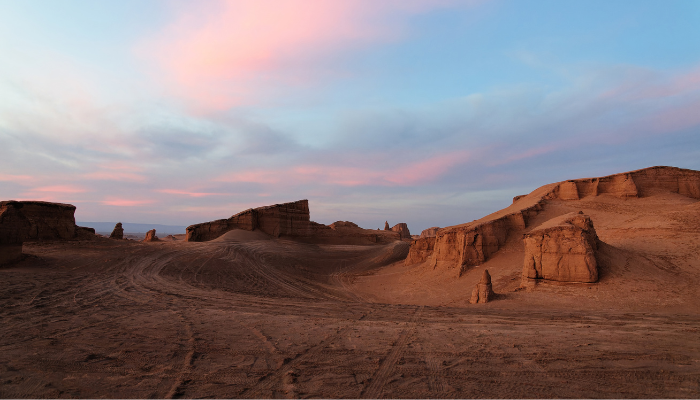
Image: 2020-01-02 Iran, Kerman, Dasht-e Lut DSC 9973 DxO by Lrkrol on Wikimedia Commons. CC BY-4.0. Image cropped.

Entry last updated: 7/10/26
Introduction
Deserts are among the world’s most unique biomes. They can be cold, hot, rocky and sandy. They are home to plants and animals that have adapted to harsh desert climates, desert terrain and scanty rainfall (low amounts of rain). In spite of their harsh environments, deserts play an important role in our natural world.
Well-known deserts
The most famous deserts in the world include:
Antarctic Desert: A polar desert at the South Pole. It is the largest desert in the world and receives very little rainfall.
Arctic Desert: A Polar desert located at the North Pole. It is snow-covered with very low annual rainfall.
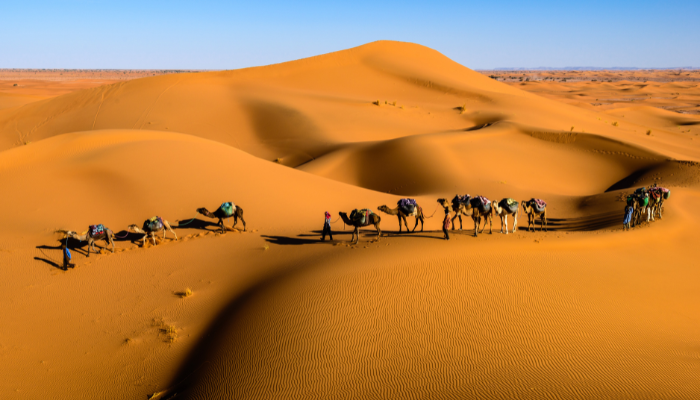
Sahara Desert: The largest hot desert in the world. It covers a large part of North Africa.
Arabian Desert: Mostly located in Saudi Arabia. It is the largest desert in Asia.
Gobi Desert: This cold desert gets frost and sometimes snow. It stretches across southern Mongolia and northwest China.
Kalahari Desert: A large sandy desert in southern Africa. It is home to lions, cheetahs and leopards.
Great Victoria Desert: The largest desert in Australia. It is covered with sand dunes and sand hills.
Patagonian Desert: A desert Argentina also known as the Patagonian Steppe.
Syrian Desert: A dry, flat desert. It stretches across northern Saudi Arabia, eastern Jordan, southern Syria and western Iraq.
Great Basin Desert: This cold desert is the largest in the USA.
Deserts around the world
Have a look through these websites to find information about deserts around the world.
Britannica School is part of the EPIC databases put together especially for New Zealand school students. It helps to answer questions like this. You will find lots of information about deserts around the world.
Search for 'desert' to find desert (ecology) and other articles about desert animals.
Or search for a specific desert like the Gobi or Great Victoria Desert.
You can get more or less information by changing the Level in the Navigator.
Tips: To use the EPIC resources you will need a password from your school librarian. Or you can chat with one of our AnyQuestions librarians. Your public library may have some EPIC databases too.
Ducksters is an educational site covering subjects like history, science, geography, , and more. The pages on this site are easy to read and understand.
Go to Geography from the list of topics at the top of the page.
Look down the page to find a list of Geographical Features.
Select Deserts at the bottom of the list.
This article has information about desert geography and famous deserts around the world.
Tips: Some websites have advertisements (or ads) which ask us to buy something or tell us to ‘click here’. It’s best to ignore these ads and focus on the information we’re looking for.
This website about travel tips for kids has been put together by a teacher and a team of young people. It has interesting facts on a range of countries and continents, including deserts.
The tab Fun Facts has a link to deserts.
It has desert facts and information on 12 deserts around the world.
Tips: Company websites (with .com or .co) can have useful info, but we need to check how reliable it is. Check the About us link on the website, if you can find one. That can tell you what the company’s mission and values are.
Types of deserts
Use these websites to find out about the different types of deserts and their main features.
This is part of the National Geographic website. We like that it shows the reading level of articles. It also explains difficult words when you hover over or select underlined text.
Enter the keyword 'desert' into the search bar.
Choose Desert.
This entry has information about the different kinds of deserts eg coastal deserts, subtropical deserts, and rain shadow deserts.
The section on Desert Characteristics is about the impact of rain, wind and temperature in a desert.
Tips: Websites with .org or .net in the address can have useful info, but you need to check that it’s reliable. Check the About us link on the website, if you can find one. That can tell you what the organisation’s mission and values are.
This website is from a United States broadcaster. It has lots of educational videos and media.
If you're asked to choose a grade, you can start with 3-5 or 6-8.
Search for 'deserts'.
Choose Deserts | Science Trek.
This is a collection of videos about the different types of deserts and the adaptations of plants and animals.
This website has information about countries and regions all over the world, including deserts.
Ignore any ads that pop up on this website.
Find the search feature by selecting the magnifying glass in the top right corner.
Enter the keywords 'desert types' into the search.
Choose the article Types of Deserts to read about semiarid deserts, cold deserts and hot and dry deserts.
Tips: Search words are sometimes called keywords. We can leave out small words like ‘the’ and ‘of’ and choose the main ones. We can change our keywords or add more if we need to.
Plants and animals
Desert plants and animals have specially adapted to survive in dry conditions. Explore these websites to learn more about how they live and thrive in desert environments.
Britannica School is a reliable source of information for subjects like history, geography, science, biographies, news and interesting facts.
Enter the keyword 'deserts' into the search box at the top of the page.
The desert (ecology) article has a section about desert plants and animals.
Or search using keywords like 'desert plants' and 'desert animals' to find information on desert life around theworld.
Tips: To get to the EPIC resources you will need a password from your school librarian first. Or you can chat with one of our AnyQuestions librarians and they will help you online. Some EPIC databases may also be available through your public library.
This is another one of the EPIC resources that needs a password from AnyQuestions or your school librarian. It has some really good and easy-to-understand information about desert plants.
Choose Plants from the topics on the homepage.
Next, select Types of plants.
Then choose Desert Plants to find articles, images, videos and more.
Or, enter 'desert animals' into the search box to find the article Desert animals.
This is the website of one of the most famous zoos in the world. They have information about lots of different animals. To find out about animals and plants that live in the desert, follow this pathway:
From the top of the homepage, choose Habitats.
Under the heading Browse by habitat, choose Desert.
Tips: Websites with .org or .net in the address can have useful info, but you need to check that it’s reliable. Check the About us link on the website, if you can find one. That can tell you what the organisation’s mission and values are.
Conservation
Deserts need protection because they are home to many plants, animals and people. Use these websites to learn about threats to deserts like mining and climate change. Also find out how people are working to protect them.
The World Wide Fund for Nature (also known as the World Wildlife Fund) is a leading organisation for conservation of wildlife and endangered species. They aim to preserve the world's wildlife and reduce human impact on the environment.
Enter the keyword 'deserts' into the search box at the top of the page.
Go to Chihuahuan Desert,
Then look down the page to read about the threats to this desert and the plans of WWF to protect it.
Or, search for 'desert mining' to find the article Preventing plant extinctions in the Richtersveld, South Africa.
Tips: This website may show a donation request at the top of the page. If it appears, close the message and focus on finding the information you need on the site.
Defenders of Wildlife is a conservation organisation. Their main aim is to protect all native animals and plants in their natural habitats.
Go to the tab Wild places from the top of the page.
Look for Deserts to read about desert conservation work.
Tips: You may see a message about cookies on this website. Cookies are a data collector some websites use to collect user information.
Books
There are lots of books about deserts. Check your school library or public library to see what they have.
Some recommended titles are:
The Sahara by Christina Webb
In a Desert by Sarah Ridley
Hoot and howl across the desert: life in the world's driest deserts by Vassiliki Tzomaka
In the desert by Michaela Weglinski.
Tips: For security, websites sometimes ask you to prove you're a real person. They show a message like 'I’m not a robot' or 'Verify you are human'. It is safe to tick the box to use the website.
SCIS no. 1965591
Topics covered
Related content
Sahara
Where can I find information about the Sahara?
Adaptation
Where can I find information about plant and animal adaptation?

Animals
Where can I find information about different animals?

Wonders of the World
Where can I find information about the Wonders of the World?

Himalayas
Where can I find information about the Himalayas?