
Floating and sinking
Where can I find information about floating and sinking?
(Years 5-8)
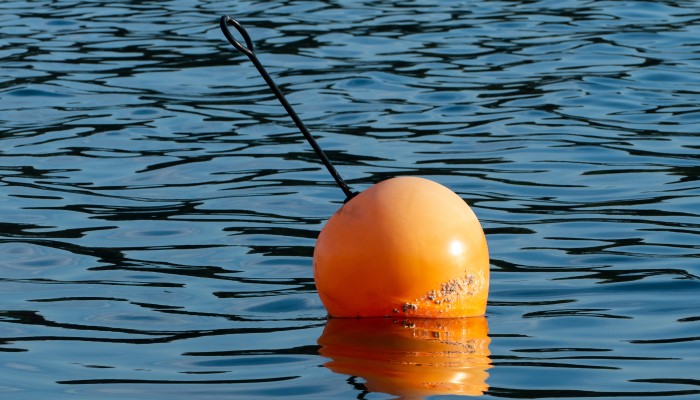
Image: Orange buoy in water by W.carter on Wikimedia Commons. CC 1.0. Image cropped.

Entry last updated: 28/07/26
Introduction
Floating and sinking depend on an object’s weight and the upward force of water (upthrust). If the object’s weight is less than the upthrust, it floats; if the object’s weight is more than the upthrust, it sinks. Objects float or sink based on the law of buoyancy. This law is also called Archimedes’ principle, after the Greek scientist who discovered it.
General websites
Here are some great websites for information about floating and sinking.
This website is great for science topics for New Zealand students. It has articles, activities and videos and was put together by the University of Waikato and Curious Minds (NZ).
Enter 'floating and sinking' into the search bar.
Choose Floating and sinking — exploring forces or Physical World – Floating and sinking.
Use the search word 'buoyancy' to find Building Science Concepts: Floating and sinking.
This will help you understand the concepts of floating and sinking.
Tips: Search words, or keywords, are the most important words in our question. Usually it’s better to leave out small words like ‘the’, ‘a’ and ‘of’ and just choose the main ones, eg floating. We can always change our keywords or add more if we need to.
Britannica School is part of EPIC, a collection of reliable databases covering lots of different topics. It’s put together especially for New Zealand school students and helps to answer questions like this.
Search for 'buoyancy'.
Choose Archimedes' principle (physics).
This article is about Archimedes' law of buoyancy that explains why some objects sink while others float.
Tips: To get to the EPIC resources you will need a password from your school librarian first. Or you can chat with one of our AnyQuestions librarians and they will help you online. Some EPIC databases may also be available through your public library.
This website is from a United States broadcaster. It has lots of educational videos and media, including some about floating and sinking.
Find the search bar at the top of the page.
Try searching for 'floating and sinking' or 'buoyancy'.
Check out the video How Do Ships Float? or a video showing an experiment with Density and Buoyancy.
Tips: There are lots of videos on this site, but you might need to use different search words to find them. For example, if you do a search for 'float and sink' you can find a fun video called Whatever floats your boat. This site is for teachers so some information is aimed at adults.
This website helps students understand science and technology using easy explanations, real-life examples, and safe, reliable information.
Enter the words 'floating and sinking' into the search box at the top of the page.
Explore the link Ships and boats | How they float?
Look for the link Upthrust — made simple to understand what happens as you load a ship.
Try other links from the results page, such as The science of swimming and How do submarines work, to know more about floating and sinking.
Each article has the name of the person who created it and when it was written or updated.
Tips: Websites that have .com or .co in the address can have good information, but you need to assess how reliable it is. Check the About us link on this website. That can tell you what the company’s mission and values are.
Books
Your local public library and school library may have books on floating and sinking. Here are some titles we have found:
Fantastic forces and incredible machines by Nick Arnold
Captain Kidd's crew experiments with sinking and floating by Mark Weakland
Why do ice cubes float? by Benjamin Proudfit
What floats? What sinks? : a look at density by Jennifer Boothroyd.
SCIS no: 1960269
Topics covered
Related content
Physics (junior)
When can I find information about physics?
Biology (junior)
Where can I find facts and information about biology?
Adaptation
Where can I find information about plant and animal adaptation?

Scientists (New Zealand)
Where can I find information about New Zealand scientists?
Oceans
Where can I find information about oceans?
Sailing
Where can I find information about sailing?

Flight
Where can I find information about flight and how things fly?