
Volcanoes (New Zealand)
Where can I find information about volcanoes in New Zealand?
(Years 5-8)
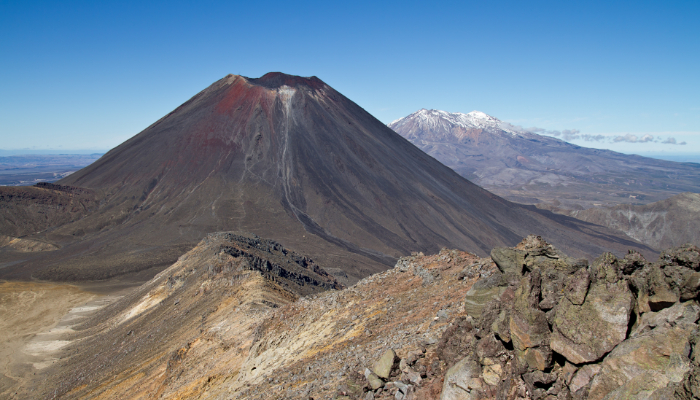
Image: Le Ngauruhoe et le Ruapehu vus du sommet du Tongariro by Eusebius (Guillaume Piolle) on Wikimedia Commons. CC by 3.0. Image cropped.

Entry last updated: 16/03/26
Introduction
A volcano is a vent (opening) in the earth's crust. These vents allow magma (molten rock) to erupt as lava, a mixture of liquid rocks, ash and poisonous gases. Aotearoa New Zealand has many volcanoes, mostly in the North Island. The main types of volcanoes found here are cone volcanoes, shield volcanoes, caldera volcanoes, and volcanic fields.
List of New Zealand volcanoes
Here is a list of the most well-known volcanoes in New Zealand.
Auckland volcanic field: There are around 50 separate volcanoes in the Auckland volcanic field.
Kermadec Islands: These islands are part of a chain of undersea volcanoes at the northernmost point of New Zealand.
Mayor Island: Although dormant, this shield volcano in the Bay of Plenty is still considered active.
Ngauruhoe: Located in the Tongariro National Park this is an active composite cone volcano.
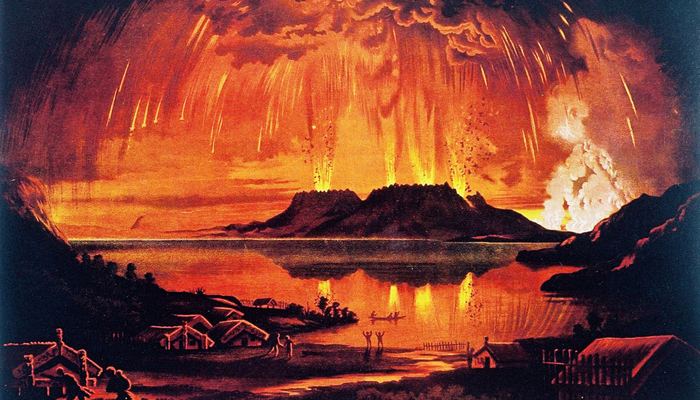
Okataina: This volcanic centre is an area in Taupō with many recently active vents, including Mt Tarawera, which erupted in 1886.
Rotorua: The Caldera volcanic eruption that took place in Rotorua 240,000 years ago left behind a large crater in the earth, which is now Lake Rotorua.
Ruapehu: The highest peak in the North Island, this active composite cone volcano is also a stratovolcano.
Taranaki/Egmont: New Zealand’s largest mainland volcanic cone, is located on the west coast of the North Island. It is an active volcano, and last erupted around 1854.
Tongariro: This volcano in the Taupō volcanic zone last erupted in 2012. It is made up of a large area of volcanic cones and craters.
White Island: New Zealand’s most active cone volcano over 150,000 years is mostly under the sea. It is located close to the Bay of Plenty.
Tips: Before searching, make a list of words to use. These are sometimes called keywords. They can be the name of a person, place, or event you are researching.
General websites
Volcanic eruptions have helped shape the landscape of Aotearoa New Zealand. Some of the largest known eruptions throughout the world are the explosions at Taupō, Mount Tarawera, Ngāuruhoe and Ruapehu.
The Science Learning Hub is written by New Zealand teachers and scientists. It is a great site to learn about how volcanoes work and the sort of volcanoes we have here.
Search for 'New Zealand volcanoes'.
Open the article New Zealand volcanoes or look at Volcanoes - timeline to find out about earlier eruptions.
Check out Plate tectonics, volcanoes and earthquakes to understand the role of tectonic plates in volcanic eruptions.
Tips: Some of the difficult words in these articles are underlined. If you hover over the word it explains what it means.
Te Ara The Encyclopedia of New Zealand
Te Ara is an excellent starting point for all questions about Aotearoa New Zealand. If we look down to the bottom of the page, we can see that the website belongs to Manatū Taonga Ministry for Culture & Heritage, so the information is well-researched and reliable.
Enter the keyword 'volcano' into the search box.
Read the article volcanoes to find out about types of volcanoes and the difference between active, dormant and extinct volcanoes.
The link Pacific Ring of Fire explains what this area means to New Zealand and the kind of volcanoes found here.
You can also search for a particular volcano or eruptions that happened in the past, like 'Tarawera eruption'.
Tips: Sites that have .govt.nz or .ac.nz are from NZ government or educational organisations. We like sites like this because they’re reliable and relevant to us.
This website about New Zealand earth science has information about landforms and topics like earthquakes and volcanoes.
Go down the page and select Natural Hazards and Risks.
Choose the topic Volcanoes.
Down the bottom there are links to more pages, like Volcano types, or Volcanic hazards, which has safety tips on what to do in case of an eruption.
Tips: Many web pages have links to further information or to other recommended sites. Following these links is a great way to find out more.
GeoNet was set up to keep an eye on volcanic activity and earthquakes in Aotearoa New Zealand.
Select Volcano at the top of the page, then choose Volcanoes.
Use the red drop down button to select the volcano you want, like
The About tab for each volcano has an image and facts, including when it last erupted.
Tips: Websites with .org or .net in the address can have useful info, but you need to check that it’s reliable. Check the About link on the website, if you can find one. That can tell you what the organisation’s mission and values are.
This website has been put together by the National Emergency Management Agency (NEMA). It has information on what to do before, after, and during different types of emergencies.
Select the In an emergency tab and choose Volcanic activity.
Look down the page for information on what to do.
Books
There are some great books written about New Zealand volcanoes.
Some recommended titles are:
Eruption! : discovering New Zealand volcanoes by Maria Gill
Volcanoes and thermal wonders by Gordon Ell
Volcanoes and earthquakes by Gordon Ell and Sarah Ell
Awesome forces : the natural hazards that threaten New Zealand by Geoffery R F Hicks and Hamish Campbell
SCIS no: 1940903
Topics covered
Related content
Mountains (New Zealand)
Where can I find information about New Zealand mountains?
Natural disasters (NZ)
Where can I find information about natural disasters in New Zealand?
Earthquakes
Where can I find information about earthquakes?
Mount Tarawera eruption 1886
Where can I find information about the eruption of Mount Tarawera in 1886?